
Best Search & Tactical Flashlight 2026
Best Search & Tactical Flashlight - updated version with everything you need to know about the next generation of search and tactical flashlights
In 2016, we wrote "Best Search & Tactical Flashlight - choosing the best search and tactical flashlight". An article that, together with "Wild boar tracking/searching without a dog", is among the most read.
We launched our first specially developed search and tactical flashlights in 2012. Ever since then, our goal has been to drive development and stay at the absolute forefront in this field.
Both we and our industry colleagues are currently in full swing with the production of the next generation of search and tactical flashlights, and here we give you an insight into the latest news.
As a hunter, it is easy to get blinded by marketing jargon and unnecessary "features" while running the risk of missing essential functionality. In addition, there are a number of deeply rooted misconceptions that are good to be aware of.
A good example is the discussion about whether search and tactical flashlights should have green or white light.
In this article, you will learn why we recommend one but not the other. And everything else that is good to know in order to choose the best search and tactical flashlight based on your needs.
Contents
Search & Tactical Flashlight - green or white light
Search & tactical flashlight vs hunting light
The search & tactical flashlight's lumens and the width of the light
Mount for the search & tactical flashlight
Compact mounts for the search & tactical flashlight
Mount for weapons with a sound suppressor
The lighting the hunter needs
Other things to consider
Search & Tactical Flashlight - green or white light
Unfortunately, a widespread use of the word "search and tactical flashlight" has created some conceptual confusion.
As the name suggests, search and tactical flashlights are used for tracking/searching.
It is therefore important to distinguish between "tracking/searching" and "hunting". Especially since they are legally separated and governed by partially different regulations. Simply put, "hunting" transitions into "tracking/searching" when you have confirmed or suspect a wounding shot.

To reduce the suffering of wounded game, the law grants the hunter a number of increased powers during tracking/searching. This includes the right to use weapon-mounted lighting to reach a conclusion more quickly.
Tracking/searching may also be necessary when game is injured in traffic, but follows a separate regulatory framework and is handled by tracking/searching hunters specially appointed by the police.
New since our previous article is that it is now (as of May 15, 2019) permitted to use weapon-mounted lamps even when hunting wild boar, §14a Hunting Ordinance (1987:905). (NOTE! The reader is responsible for staying up to date with the laws in effect at the time.)
The purpose and needs differ somewhat between hunting and tracking/searching. Therefore, there is reason to clarify the difference between a "search and tactical flashlight" and a "hunting light."
Search & tactical flashlight vs hunting light
The primary purpose of a search and tactical flashlight is to provide the best possible conditions for tracking/searching wounded game.
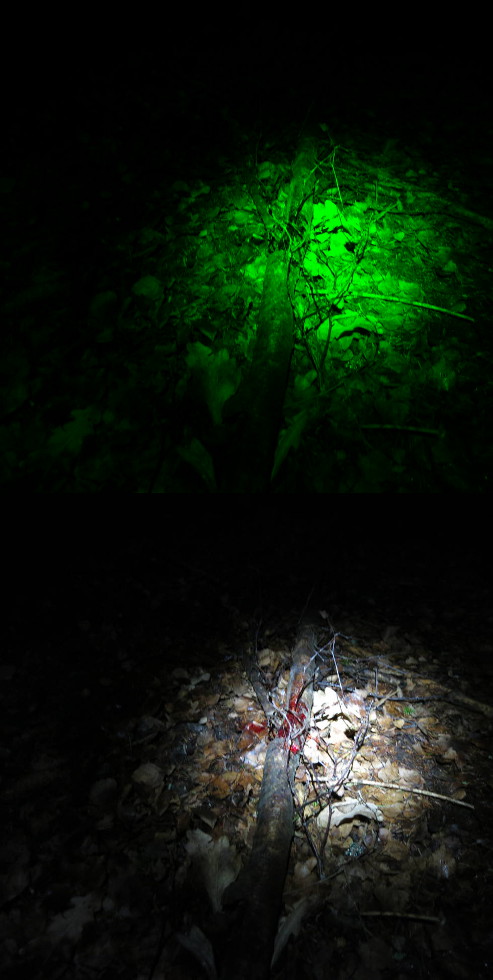
The search and tactical flashlight should therefore always have a powerful white light in the correct frequency range for the following reasons:
- The human eye is most sensitive to white light. Simply put: A flashlight with white light requires less power to be perceived as equally sharp as one with green light.
- White light is superior to green light when it comes to tracking blood. A search and tactical flashlight with white light in the correct frequency range makes blood trails appear clearly. Green light, on the other hand, makes blood trails appear black and much harder to see.
- Furthermore, white light is superior when it comes to distinguishing between the tracking/searching dog and the wild boar in tight situations. So even from a safety perspective, white light is preferable.
- Wild boar are generally insensitive to both white and green light, especially if the light comes from slightly above, e.g., a hunting tower. Even when the light comes directly at the boar's eye level, e.g., during kneeling shooting on flat fields, the animals usually are not disturbed enough to prevent a shot from being fired in an orderly manner.
The primary purpose of a hunting light, on the other hand, is to give the hunter enough light to assess the hunting situation (shootable or non-shootable game, bullet backstop, etc.) without scaring the hunted game.
As a hunting light for wild boar hunting, both green and white light work well. What is best depends mainly on personal preferences but also on weather conditions. Many hunters prefer green light. Especially in winter environments, green light can be perceived as gentler on the eyes. Additionally, many animal species have more difficulty perceiving green light and do not react to it at all.
A good search and tactical flashlight with green light & white light offers the greatest flexibility and the ability to choose the best light for each situation.
Colors other than green and white are rarely relevant for search and tactical flashlights because the human eye has difficulty utilizing such light. Blue/"cold" lights generally provide very poor illumination, and contrast is significantly reduced. Red light is usually completely unsuitable in these contexts because animals are more sensitive to it and react more strongly than to white light.
The search & tactical flashlight's lumens and the width of the light
Lumens, lumens, lumens. If you don't know what to measure, you measure what you can. When it comes to search and tactical flashlights, a lumen hysteria has emerged that is disproportionate to the importance of this feature for a search and tactical flashlight.
The result is a lumen war with, in many cases, astonishing specifications. A number of years ago, good flashlights had a few hundred lumens; now it is not uncommon to find flashlights claimed to have over 1000 lumens.
Of course, it is important to have a search and tactical flashlight that allows you to see far enough. However, there is no advantage to having a flashlight so bright that you are completely blinded and lose your night vision. It is also worth considering that the higher the lumens and power consumption, the faster the battery runs out.
How far you can see with a search and tactical flashlight depends on several factors:
- The quality of the lamp module and its reflector
- The quality of the batteries
- The flashlight's color spectrum
The stated lumen value at best provides an indication of the flashlight's performance ambitions, but ultimately says very little about its suitability for hunting and tracking/searching.
Have you played funnel football? Then you know the difficulty of too narrow a field of view.
Here you can see the difference between a flashlight with a wide beam compared to a flashlight with zoom and a narrow beam.
When it comes to search and tactical flashlights, the most common question among new hunters is how far the flashlight shines. More experienced hunters who have done some tracking/searching are usually significantly more interested in how wide the light is.
How wide the flashlight's beam is is rarely stated in the specifications, and there is a big difference from flashlight to flashlight because several factors interact. The lamp module, the design of the reflector, and even the front edge of the lamp housing can affect how wide the actual beam becomes.
jaktkit's search and tactical flashlights have been designed in collaboration with experienced tracking/searching hunters and provide up to 21% wider light than ordinary search and tactical flashlights.
This increases the overview and simplifies follow-up shots.
Mount for the search & tactical flashlight
When it comes to mounts for the search and tactical flashlight, personal preference plays a big role, but certain things should be considered.
Compact mounts for the search & tactical flashlight
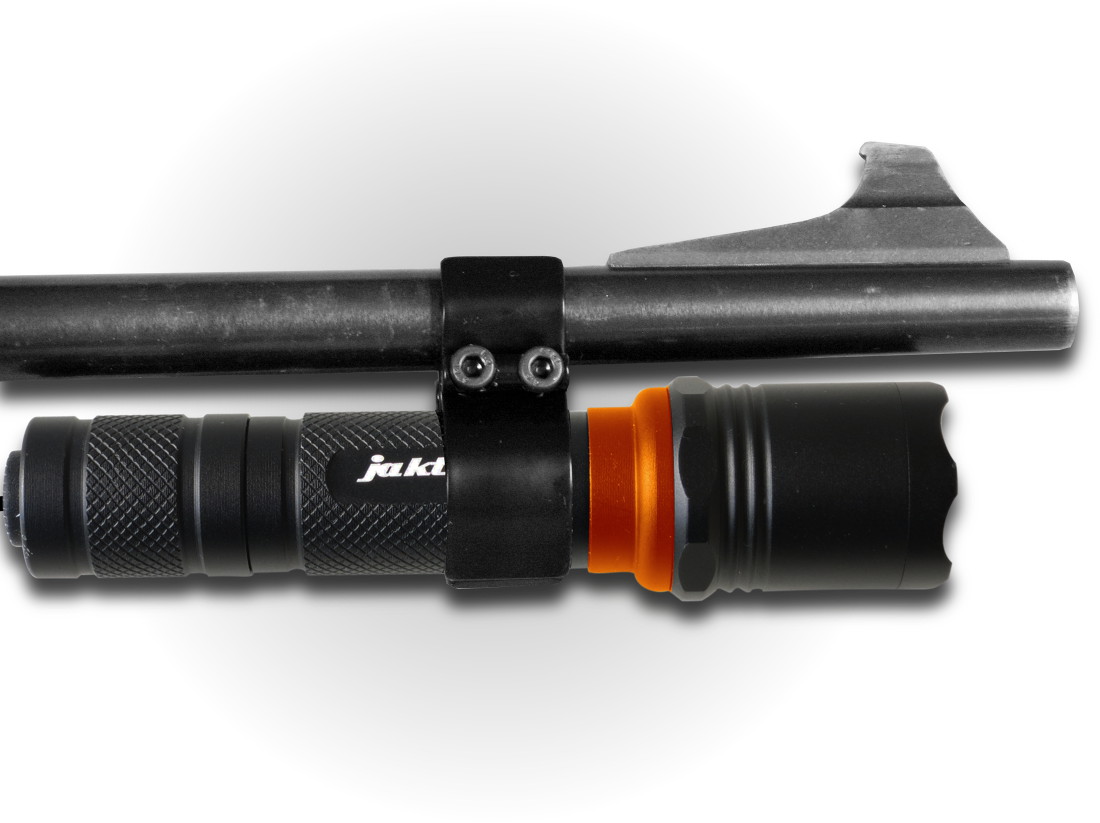
Smooth and compact mounts for the search and tactical flashlight are less likely to snag on terrain and bump into things. There are few things as annoying as scaring away the wild boar because you accidentally hit the flashlight on the edge of the hunting tower or the window frame of the hide when setting up.
Additionally, you should test fire thoroughly to ensure that the mount can handle the recoil and really holds the flashlight securely. It is both dangerous and unpleasant if the flashlight flies off when you are face to face with a wounded wild boar in the dark forest.
There are different theories about where the search and tactical flashlight should be mounted. We recommend mounting the search and tactical flashlight on the barrel near the muzzle so that the barrel does not cast a shadow on the beam. The disadvantage is that the flashlight can affect the weapon's point of impact. This must of course be checked at the shooting range, but our tests have shown that changes in point of impact are usually negligible in relation to the moderate shooting distances normally involved in tracking/searching or night hunting.
Additionally, you can advantageously have the flashlight permanently mounted. Then you know it is in place when you need it. Moreover, the weapon is zeroed and ready with the flashlight attached. One less thing to fiddle with when it's time for tracking/searching. A nice side effect is that the point of impact often becomes tighter with the search and tactical flashlight mounted. This is because the increased weight at the barrel end reduces the vibration caused by the bullet's rotation in the barrel.
It is always better to have a mount that stays securely in place even if it takes slightly longer to attach. Quick-release mounts that you cannot rely on are no fun when things get serious, no matter how easy and fast they are to attach.
Mount Fix - mount for search and tactical flashlight is developed to be both recoil-proof and compact for the best search and tactical flashlight mounting.
Mount for weapons with a sound suppressor

For mounting a search and tactical flashlight on a weapon with a sound suppressor, a more extensive and specially adapted mount may be required.
Even for weapons with a sound suppressor, it is often best to mount the flashlight on the barrel. Preferably directly behind the suppressor and with the flashlight pushed forward under the suppressor.
If the shape or length of the suppressor does not allow mounting on the barrel, the same mount can be used for mounting on the weapon's scope. However, this is not something we recommend for the following reasons:
- The scope and rings are the weapon's most sensitive parts and should not be subjected to unnecessary strain.
- The pressure switch and its cable risk getting in the way of the bolt action/feeding.
- The barrel risks casting a shadow over parts of the light image.
The lighting the hunter needs

For tracking/searching and wild boar hunting, you need 3 flashlights to cover all your needs:
- A headlamp - The headlamp should have adjustable light intensity so that you can use it on low intensity to and from the hunting stand. It can advantageously have both green and white light. However, strobe, SOS, and other "features" are usually more disturbing than useful. Additionally, it can be good if the headlamp starts on low intensity and increases gradually, rather than the other way around. You easily scare both the animals and yourself if you are always forced to start at full intensity when sneaking to and from the stand.
- A weapon-mounted search and tactical flashlight - This should have white light to simplify blood tracking and increase the chances of distinguishing between wild boar and the tracking/searching dog in tight, fast situations. Green light can possibly be used during the actual hunting.
- A handheld search and tactical flashlight - This should, like the mounted search and tactical flashlight, have a powerful white light. The flashlight is used to safely and conveniently illuminate areas where the bullet backstop and shooting directions are uncertain.
In addition to that, it is always good to have a knife. If you shoot large pigs, it is also good to have a rope in the car or the hide so it is easier to drag it out.
And the rifle, of course.
Other things to consider
It is often convenient to be able to turn the search and tactical flashlight on and off with a switch attached to the weapon's fore-end. If you regularly go on tracking/searching in dense terrain, you can expect them to snag and break from time to time.
Ensure that spare parts can be repurchased at a reasonable price.
Check the quality of the batteries. High-quality batteries are expensive but are a prerequisite for a search and tactical flashlight to achieve its full performance. Therefore, you should not neglect this in your purchasing decision.
Do not confuse flashlights disguised as "search and tactical flashlights" with a real search and tactical flashlight. They can look virtually identical on the outside. However, a search and tactical flashlight is manufactured to withstand the great forces of the weapon's recoil and other strains in the forest. This places entirely different demands on internal components than what you can both expect and are willing to pay for in a regular flashlight.
jaktkit's test-winning search and tactical flashlights are developed by experienced tracking/searching hunters to handle the task.
You can read more about and buy jaktkit's search and tactical flashlights here.
Did we miss something? Let us know!
//jaktkit.com